Feeling weighed down by credit card debt? Here’s why personal loans are becoming the preferred solution
Carrying credit card debt with interest rates soaring above 22% APR? Discover how personal loans can help lower your expenses, what the current rates are following the Fed's recent increase, and the ideal timing for making the switch.
Beware: minimum payments keep you trapped in debt
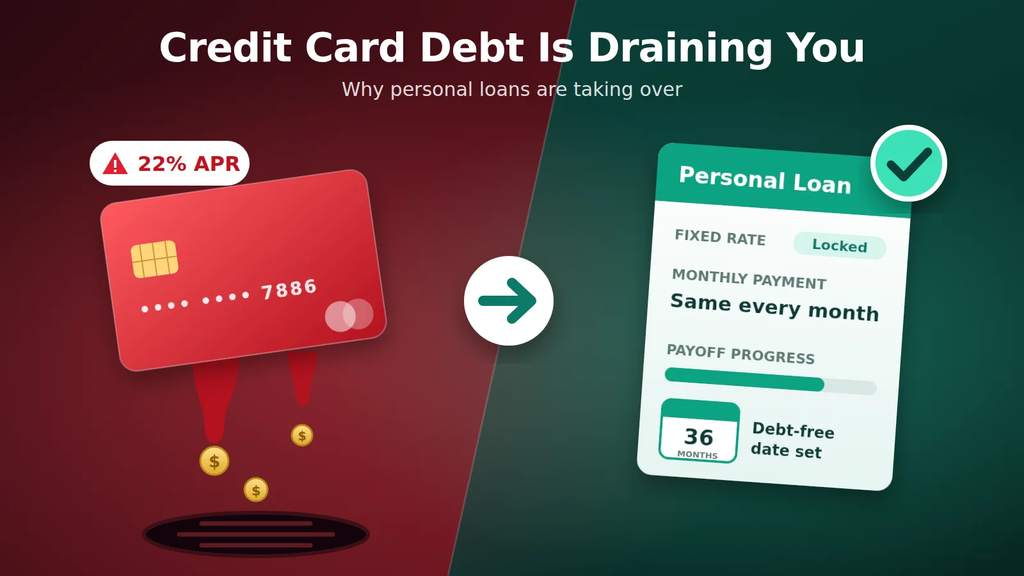
Credit card debt is wearing you down, and it’s not just in your imagination.
If you looked at your September bill and noticed back-to-school expenses added to a balance that never seems to shrink, you’re far from alone.
According to the Federal Reserve Bank of New York, Americans currently owe $1.263 trillion in credit card debt.
The upshot: millions of borrowers are quietly shifting their credit card debt into personal loans.
These personal loans come with fixed interest rates, consistent monthly payments, and a clear payoff date. We’ll explore why this shift is happening, what the data reveals, and how to decide if it’s right for you.
H2: Why Credit Card Debt Is Hurting Your Finances Right Now
According to the latest Federal Reserve figures, the average APR on credit card accounts that charge interest stands at 22.15%. Rates vary based on credit quality. WalletHub reports that new card offers average 27.01% for fair credit and 23.27% for good credit.
With an APR of 22.15%, carrying an average balance of $7,886 means you’re paying roughly $146 each month just in interest. This amount never reduces your principal balance.
The September Fed rate increase makes things tougher
The FOMC unanimously voted 12–0 to increase the federal funds rate to a range of 3.75%–4.00%.
Fed Chair Kevin Warsh stated that “inflation remains too high and has persisted for far too long.” Inflation currently stands at 3.4%, and 16 out of 18 officials anticipate at least one more rate increase before the end of the year.
Since most credit cards have variable APRs linked to the prime rate, these increases directly affect your interest costs.
Ted Rossman, former lead analyst at Bankrate, notes that changes in Fed rates typically “pass through to consumers within one or two months” and impact both new charges and existing balances.
Back-to-school expenses have just arrived
Charges from August are now appearing on September credit card bills. According to a NerdWallet poll, 19% of parents expected to carry credit card debt due to back-to-school expenses, while 24% intended to use Buy Now, Pay Later options.
An Increasing Number of People Are Falling Behind
The New York Fed reveals that the portion of credit card balances entering serious delinquency (90+ days past due) climbed to 6.97% in the second quarter of 2026.
Joelle Scally, Economic Policy Advisor at the NY Fed, cautioned that “new delinquencies on auto loans and credit cards continue to remain at high levels.”
How Much Could You Save by Making the Switch?
Can consolidating debt improve your credit score?
Yes, it often does. According to a study by TransUnion, 68% of people who consolidated their debts saw their credit scores climb by over 20 points.
The average credit card balance decreased from $14,015 to $5,855. “Debt consolidation loans generally achieve the goals they’re meant for,” said Liz Pagel, former Senior Vice President at TransUnion.
H2: Is a Personal Loan the Right Choice for You?
When a personal loan is a smart option
- Your new loan APR is clearly lower than your card APR, fees included;
- You can afford the fixed monthly payment comfortably;
- You’re committed to not running your cards back up after paying them off;
- Your credit score is 690 or higher, which puts you in the better rate tiers.
Risks You Should Be Aware Of
- Origination fees: some lenders deduct them from your loan, so compare the APR, not just the interest rate;
- Fair or bad credit: average rates of 23.73% to 27.27% may not beat your card;
- Rising delinquencies: personal loan delinquency (60+ days) climbed to 3.81%. Borrow only what you can repay;
- Don’t count on a rate cap: the proposed 10% credit card interest cap is not law. Waiting for it could cost you months of interest.
How to Transition from Credit Card Debt to a Personal Loan in Five Steps
Step 1: Write Down Every Card Balance and Its APR
Before reaching out to any lender, be sure you fully understand how much you owe and the cost of that debt. Grab your latest statement for each credit card and note down:
Find the “Interest Charge” section on each statement. This amount represents what you pay monthly without lowering your actual balance at all.
The typical balance is $7,886 with an average APR of 22.15%. With these figures, interest costs roughly $146 per month.
Step 2: Get Your Credit Score for Free
Your credit score is the most important factor in determining your loan rate. The gap between different score levels can be significant:
Source: NerdWallet, September 2026.
You can check your credit score at no cost via most banks and credit card providers.
To access your complete credit reports, visit AnnualCreditReport.com, the official website offering free weekly credit reports from Equifax, Experian, and TransUnion.
Step 3: Prequalify With at Least Three Lenders
Prequalifying lets you see your estimated interest rate, loan amount, and monthly payment without affecting your credit score, since lenders perform only a soft credit check.
A hard credit check only occurs when you officially apply for the loan.
Make sure to compare at least one lender from each of these groups:
- Online lenders: fast decisions, often with funding in days, and easy online prequalification;
- Banks: may offer lower rates if you’re already a customer. The Fed reports 11.86% as the average on 24-month bank personal loans;
- Credit unions: federal credit unions are generally limited to an 18% APR ceiling. That makes them a strong option if your credit isn’t perfect.
Pro tip: seek out lenders that provide “direct pay to creditors” options, so the funds go straight to your credit card companies and never pass through your bank account.
Step 4: Evaluate APR, Fees, and Overall Expenses
The advertised rate rarely tells the whole story. Be sure to compare these details carefully:
- APR, not just interest rate: APR factors in origination fees to show the true annual cost;
- Origination fee: some lenders deduct this upfront. Example: a 5% fee means you’d need to borrow about $8,301 to get $7,886 net to clear your cards;
- Loan term: longer terms reduce monthly payments but increase total interest paid;
- Prepayment penalty: confirm you can pay off early without extra fees.
See how different loan lengths affect the cost for the same $7,886 at a 19.55% APR:
H3: Step 5: Immediately Pay Off Your Cards and Activate Autopay
Once your loan has been approved and funded, take action on the same day:
- Pay every card balance in full. If your lender offered direct pay, confirm the payments went through;
- Check each card account a few days later to confirm a $0 balance. Interest charged in the last cycle can leave a small leftover amount;
- Set up autopay on the new loan so you never miss a payment. Some lenders also give a small rate discount for autopay;
- Keep your card accounts open. Closing them can hurt your score by increasing your credit utilization and shortening your credit history.
Paying off your cards lowers your credit utilization rate, which is one of the quickest ways to boost your credit score.
A TransUnion report shows that 68% of borrowers who consolidated their debt improved their credit scores by over 20 points.
Step 6: Safeguard Your Progress to Prevent Debt from Returning
This is where many people stumble. Paying off credit cards with a loan only works if you keep those card balances at zero.
If not, you risk ending up with twice the debt.
- Take your cards out of your wallet and remove saved cards from online stores and apps;
- Plan ahead for the holidays. Holiday shopping is weeks away, so set a cash budget now, before the season starts;
- Build a small emergency fund, even $500 to $1,000. Most people rack up card debt again because of an unexpected expense, like a car repair or a medical bill;
- Turn on spending alerts in your card apps so any new charge shows up right away;
- Use your cards for one small bill only, such as a streaming service on autopay. That keeps the account active without letting a balance build up.
Author’s Perspective
Having spent over ten years reporting on personal finance, I can confidently say this moment stands apart.
Card balances are at record levels, APRs exceed 22%, and the Fed has raised rates instead of lowering them.
Families carrying balances are feeling pressure from all directions. I’ve seen many wait for rate cuts or government intervention, while their interest charges silently drain hundreds each month.
Personal loans aren’t a cure-all and won’t suit everyone. If your credit is mediocre or low, the numbers might not add up, and speaking with a counselor might be a smarter first step.
However, if you can secure a significantly lower fixed rate, locking it in before the next rate increase could be one of the smartest decisions you make this fall.

Recommended Content
Your flood insurance could lapse this month
Discover what happens when coverage ends, how the NFIP renewal window works, and what to review beforehand.
Continue reading * You will remain on the current website